Water in Lake Country, BC: sources, advisories and rates
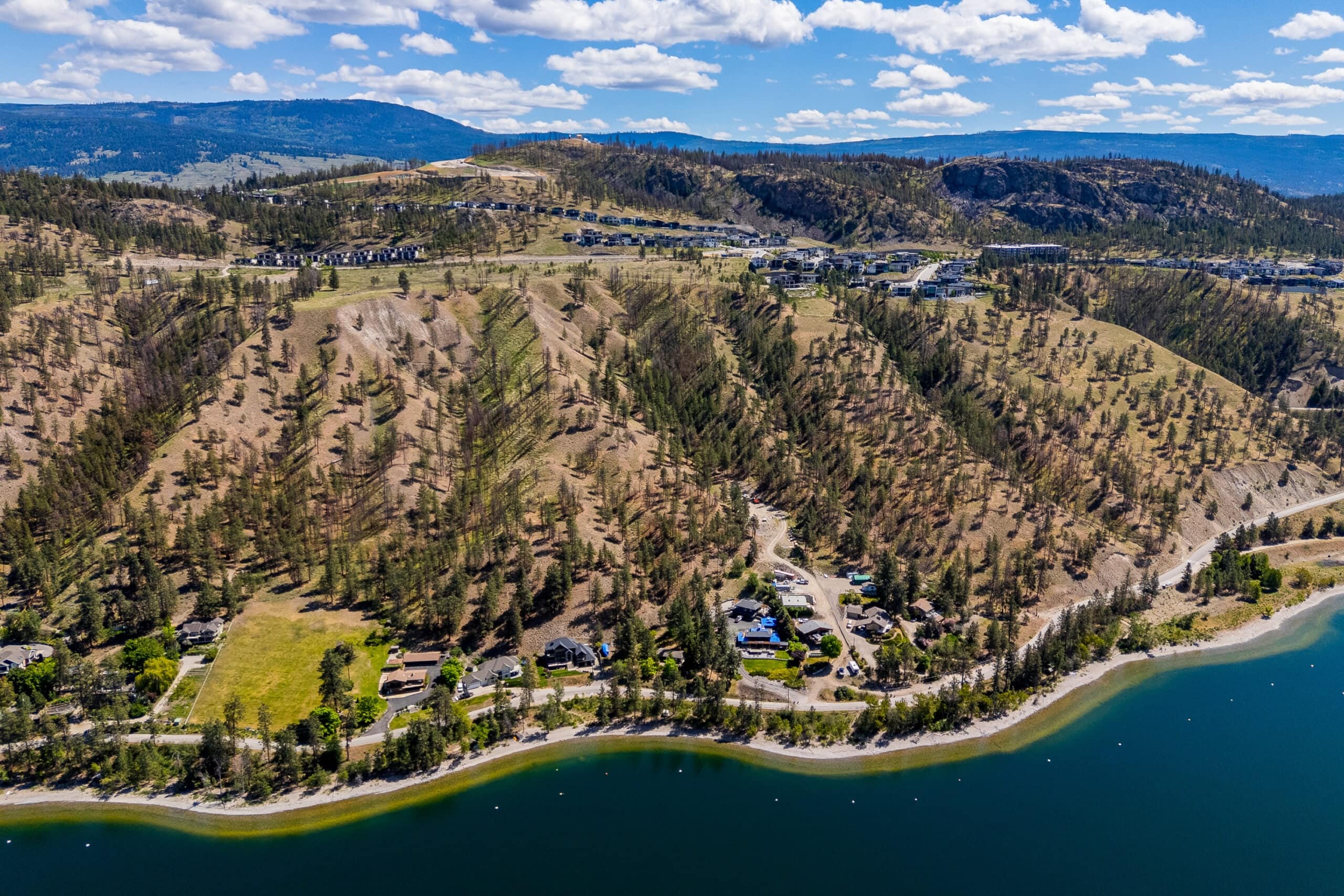
Photo: Hall Cassie Marshall Group, full caption
The Okanagan Lake shore below Tyndall Bench, Lake Country, from the air. Photograph: Hall Cassie Marshall Group.
Before you buy in Lake Country, find out which lake an address drinks from. The District runs five water sources, two of them under long-standing advisories in the irrigation season, and it bills water, sewer and garbage together. Here is what the District publishes, with each source linked.
In short
- Lake Country's water comes from five sources: Okanagan Lake, Beaver Lake, Oyama Lake, Kalamalka Lake and the Coral Beach system.
- The Beaver Lake and Oyama Lake sources have been under water quality advisories since the mid 2000s, in force from late April to September.
- A single family home pays a 2026 base rate of $610 a year plus $1.29 per cubic metre.
Sources read . Source links accompany the answers below.
Where does Lake Country's water come from?
The District draws from five sources: Okanagan Lake, which serves about 2,800 properties, Beaver Lake about 1,300, Oyama Lake about 290, and Kalamalka Lake and the Coral Beach system.
The District's water source map shows which system serves a parcel. Neighbouring streets can be on different sources, so check the address itself.1
Which Lake Country water systems have an advisory?
The Beaver Lake and Oyama Lake sources have been under water quality advisories since the mid 2000s. Kalamalka Lake, Okanagan Lake and Coral Beach have none.
For most of the year, Beaver Lake customers are supplied from Okanagan Lake, and customers on the east bench of Oyama from Kalamalka Lake. In the irrigation season, from the last week of April to September, they switch to Beaver Lake or Oyama Lake, and the advisory applies.
Interior Health oversees the District's water quality, and the District reports to it.1
What does water cost in Lake Country?
For 2026, a single family home pays a base rate of $610 a year, billed at $152.50 a quarter, plus $1.29 for each cubic metre used.
Agricultural water is $156 per acre a year, and a seasonal irrigation connection is $195 a year.
Water, sewer and garbage are billed quarterly. A balance still unpaid on 31 December moves to the property tax account as arrears and draws daily interest, so ask the seller for recent utility bills along with the tax notice.2
What does sewer cost in Lake Country?
A home connected to the District's sewer pays a user fee of $640 a year, billed at $160 a quarter. A property that can connect but has not pays a $275 non-connection fee.
A property outside the sewer areas has its own septic system; the wells and septic guide covers its records.2
Are there watering restrictions in Lake Country?
Yes. The District sets restrictions by stage, and they apply to every property on its water system, including those outside the municipal boundary. The schedule is set by the last digit of the address, and the stage changes with the weather, so check the District's current notice.
For farms, the District caps agricultural application at 27 inches, 2,700 cubic metres, per acre, with no agricultural irrigation after 15 September without its approval.3
When is irrigation water turned on in Lake Country?
Seasonal irrigation is turned on by request, typically in the third week of April, and turned off in the second week of October.
A pilot Small-Scale Farming Policy offers agricultural rates to parcels of 1 to under 2 acres in the Agricultural Land Reserve or zoned A1, with a separate irrigation connection and meter installed at the owner's expense.4
Sources
- District of Lake Country, Water Quality.
- District of Lake Country, Utility Billing.
- District of Lake Country, Water Conservation.
- District of Lake Country, General Water Information.
As published by the District of Lake Country, read 9 October 2026. Check an address on the District's water source map, and the current watering stage, before you rely on either.
If your question is not answered here, ask me.
Contact Tyler